I stumbled on this New York Magazine article via Ms. Naughty's blog, and I am truly intrigued. Not because I think that one (or even 100) pictorials of nude men will change the way male and female bodies are/not produced as 'sexual.' As with many many gender and sexuality issues, the problem is not (only) with correcting misrepresentations by merely adding to the ones we have, just like more women as corporate CEO's is not all that is needed to change the way business and economics are centered around the worker as male. It's a start, but it's not the whole story, not even close.
I'm more interested in what Ford said.[...] the male nude is one of our last taboos. There's a double standard at play here: magazines that are happy to fund ads featuring an artfully lit female nude will balk at an image of her male counterpart.
Bodies themselves may be, for the most part, natural raw material. But the value societies gives to bodies, what we see those bodies as useful for, what uses are appropriate for which bodies, how bodily qualities (i.e. beauty, strength) are defined, are all socio-cultural and ideological, thus also political.
To Ford's point, women's bodies have been constructed as inherently sexual, beautiful, and visually appealing. The sexualization of women's bodies in advertising, "erotic art," and a slew of forms of entertainment are symptoms of gender hierarchies that objectify women, and they also reproduce and reiterate their objectification in defining the 'inherent' sexuality of the female body. In our culture, women's bodies are for being looked at; they are for someone other than themselves. While these representations are a symptom of inequality and don't directly cause it, the system of representation is circular and feeds itself.
Men's bodies presented as sexual is considered an anomaly, and often is scandalous. Men's bodies are constructed as useful, instrumental things-- men's bodies do. They do work, (they 'do' women! or men!), they perform feats of strength, athleticism, agility; for most men they are means to an end-- they are incidental. The only real eroticization of male bodies is in the sex act itself, only in front of lovers. Their bodies are typically not something to be looked at and criticized publicly, causing a self-policing among men about their own physical appearance. Ford asks,Why, he asks, is it "gay" for another man to comment on another man's figure, when women can freely tell other women their boobs look great?
The beauty of male bodies, in our culture, is supposed to be limited to sexual intimacy, whereas the beauty of female bodies is for public consumption and commentary. The femininity (sex appeal) of the female body is tied to women's identities, and complementing a woman's body (in the appropriate context) has the effect of reinforcing and praising her feminine identity. Further, when women's bodies are posited as the inherently sexual ones, we are used to women's bodies being desired by both sexes: they are the ones men desire to have and women desire to be. In our cultural context, for what purpose would a het man comment on a man's body? Visually possessing women through the gaze is part of the production of masculinity and is a privilege of it; looking at bodies is tied to sexual desire. Under such a limiting construction of sexuality and "the look", what other explanation can we provide to men looking at men's bodies but an assumption of gayness?
Alanis Morisette said, " I like to think of my body as an instrument, rather than an ornament." I don't think the idea of body-as-ornament is close to the top of the list of things men are concerned with regarding their masculinity.
Because these ideas are reinforced throughout various arenas (sport, film, art, fashion, 'sexuality' as represented in pornography, etc.), and are linked to ideological power structures (gender dominance, or patriarchy), this isn't just a matter of representation. Sexual asymmetry is one of the last acceptable gendered power differentials in western society. And it's also not a matter of prudishness. My critique sexualized images of women objects to the fact that the only valued social space available for women in the realm of sexuality is being the object on display. Thus simply adding some naked men here and there does not change the structure of how sexuality is produced through particularly gendered bodies and the resulting sexual assumptions and sexual possibilities. It's lip service and a way to say, "see, they do it to men too." But in the presence of social norms and expectations that define sexual gender roles in a way that reproduces patriarchal power hierarchies, images of nude men and women are not equivalent in meaning. This is oh so apparent in comments I've heard from guys saying:
"girls [sic] are so lucky they can get paid so much to take their clothes off," or
"if I was a girl [sic] I'd love it that everyone would want to see me naked," or my favorite,
"I don't get the big deal about rape-I wish girls would force themselves on me."
Sexualization of bodies does not mean the same thing for women as for men. And since what 'sexy' looks like is also something we learn, and since we are not taught how to see men's bodies as sexual nor is it easy to find representations of eroticized male bodies (it's no surprise that lots of het women watch gay porn!), for the most part, viewing men's and women's bodies is also a different process, signifying differently to different genders.
Representations of the body as sexual are not plopped into an otherwise neutral social context, and therefore are loaded with meaning from the get-go. This quote of Ford's is rather indicative of contextual difference I have been trying to elaborate:Imagine … if our suits were entirely designed to show off our penises. Imagine if contemporary fashion demanded that you left your cock hanging outside your trousers, with perhaps just the head trussed up in a tiny pouch like a dick bra. Everyone would see our cocks all the time, in the same way that fashion features women's breasts.
Part of the problem is that women want to look...and have little to look at. Meanwhile, women's bodies are exponentially increasing in availability at the click of a mouse. And the cultural policing of women's bodies as properly sexual is undeniably inescapable. This isn't an issue of adding more naked men to the mix. I'm not sure even having an equal number of visually sexually available men and women on the internet and in film and advertising would necessarily "fix" things is the values and meanings attached to sexed bodies remains static.
Lastly, how unfortunate that this is in Britain's GQ, and not the U.S.'s.
**also, I understand that I am speaking of these issues in terms of heterosexuality, as sexuality is constructed through heteronormative culture.
Friday, May 2
Tom Ford comments on the lack of male nudity
Wednesday, April 30
On Becoming a Sexual Female, via Miley Cyrus
I tend to agree* with this analysis of the photos of Miley Cyrus in Vanity Fair that we've seen so far from Vanity Fair, that they're not "that bad."
*sidenote: Except that the bare skin and sultry looks are for your prom friends, not the American Celebritocrical Gaze. And typically you go to the prom at 17-18, not the age of 15. Mir Kamin makes the distinction quite well between these images and simply wearing a backless dress:
For me, my problem lies with the fact that she's underage and I find the picture intentionally sexual. It's not her naked back -- it's her tousled hair, her come-hither look, and the bed-sheet-esque cover; all of those things together combine to portray a post-coital vixen.(end of side-note)
But the whole thing still troubles me for a few reasons I know, and probably some I can't articulate yet. And I think the question of whether the images themselves are "that bad" isn't the real issue here.
And I've really become disappointed in Annie Leibovitz who, back in the day, took this amazing image of Yoko Ono and John Lennon that surprised our gender expectations. She has recently become more known for replicating racist images of the recent past, and now this. And while, as I said "they're not that bad" (isn't is sad we have a world of sexualized teen girls to compare this image to that we can make the judgment, 'it's not that bad'? Ugh)
This comment on Female Impersonators is quite striking and right-on, and I think it sums up what was really giving me anxiety:
a fifteen year old girl should be beginning to discover her sexuality. She should understand how her body works and why. She should appreciate her body's feelings and responses, but she should not be doing it in front of the world. To sell magazine covers.That's exactly it. In a world where women's desirability matters more than her desire or that she desires at all, this is sad yet unsurprising. This 15 year-old girl is learning the very real and 'truth' of our modern culture that posing and being socially stamped as 'sexy' is an important (if not the important) part of women's 'sexuality'. That her being sexy is defined through, well, this. I'm not denying that a 15 year-old can be a sexual being. But the problem is that our culture perpetually defines sexuality and sexiness in terms of public validation of public sexual display. And hers being a sexuality-in-process...sigh. And what were you saying about 'The Sexual Revolution'?
And Gawker's provocative take on the photos is pretty interesting: grooming for pedophilia. I would never argue that's what is consciously and absolutely going on, but it's a compelling suggestion.
And it also makes me think about how our culture "grooms" women to become public sex objects, to desire the validation it provides, to justify it to themselves until it's "no big deal." We don't live in a vacuum, and women (or girls) don't one day jump out of bed and say "I think I'd like to show my tits to strangers while I'm drunk next spring break."
I think I'm just going to leave this here for right now. Thoughts?
Keep Reading...
Tuesday, April 29
Fighting Against Breast Cancer...and Also Against Breast Cancer Campaigns
I don't remember exactly what brought this issue to my attention-- it may have been this blog post I read, which prompted me to do some additional research. But I'm pretty irritated. And frustrated.
It's the Breast Cancer awareness campaigns and anti-breast cancer t-shirts that are being manufactured, bought and worn. Disclaimer: I am 100% in favor of fund-raising, awareness, education, what have you, about breast cancer.* That's not what this is about. However, the way advocacy is framed is just as important as the advocacy, for the "way you say it" speaks just as much as "what you say."
Why am I annoyed? The message of recent campaigns, advertising, and t-shirts are centered around the idea that we need to catch breast cancer early and research for a cure in order to save breasts. Silly me, I thought we fight against cancer to save lives. And if that weren't bad enough, the reason "the breasts" must be saved will make you puke a little in your mouth. Because men love 'em. Or in sexuality-neutral terms of some of the tees, your sex partner enjoys them, or needs them to attain a sexual conquest status:

I prefer this one:
Rethink's "Booby Wall" starts off saying about it's call to upload images of your breasts: "this isn't Maxim...this is beautiful" only to be followed by "this is worth living for." Excuse me? Um, no, my breasts are not worth living for, my life is worth living for! Yeah, let's display all sort of breasts as examples of the beauty in the variety of breasts to prove that your breasts are important, valuable and worth living for. Gee, that sure sounds like an awesome initiative!
And no, this is not a case of Aw, just lighten up!-Whatever will get people to fight breast cancer-What's the Big Deal? No, sorry. This is the message women get ev-ry-where. And now when the issue is supposed to be about women's lives, we're appealing to save women's bodies?! Women's bodies are valuable regardless of what they mean to men and the male gaze, and women's lives are important regardless of their bodies. End of story.
Reasons why we fight breast cancer?
Because it kills women.
Because it takes a chunk of your life away.
Because a woman losing her breasts can make her lose out on sexual pleasure.
The "because a woman's partner may lose our on sexual pleasure" is at the bottom of the list.
That "men like looking at as many breasts as possible and anything that makes them go away should be fought against" is not on the list.
In addition to my disclaimer above, an ending disclaimer. I am not criticizing men that are involved in breast cancer organizations whatsoever. Please keep it up! I am criticizing the way that action against breast cancer is framed, and I am not saying men involved are doing so with the motivations presumed by the campaigns. Instead, I think this tee better describes these men:
The campaigns rely on a sexist framework regarding the female body and what/who it is for, and they perpetuate such sexism in the design of their campaigns.
*Even though the way breast cancer has been produced in medicalization has a very gendered element to it, in the way that the comparative silence around prostate cancer and prevention is also quite gendered. I'll write on this in the future. But for now, ponder on why it might be that we encourage women to do self-breast examinations monthly--and this is a common-knowledge thing--and we don't advocate men doing self-testicle exams. Even though considering the various tissue obstructions in the breast, it would be much easier to discover lumps in the testicles than in the breast.
(Cross-posted to The Reaction)


Thursday, April 3
Great NPR Commentary on "Horton" and gender
Living in Canada, I listen to NPR online when I can. Almost every show is available online and you can listen at any hour. I love NPR. And I love Peter Segal, host of "Wait, Wait, Don't Tell Me!" their weekly news quiz show with a panel of known comedians (such as PJ O'Rourke, Mo Rocca, and Paula Poundstone) where you get rewarded for your current events geekdom (which used to be called "civic engagement") with being able to laugh at the jokes.
So check out this great (and quick!) commentary from Peter Segal on how the revised plotline of "Horton Hears a Who" is just the same-old Hollywood gender shaping. Nothing better than a father (of girls) genuinely pissed off at the flat representations of them in movies.
My favorite part:Have the clowns who made this movie ever met a daughter? Have they dated one? If they did, did they meet the daughter's father? Did they then ask that daughter's father if there was anything more dramatic, interesting, arresting, and moving to him than his relationship with his daughter? Did they ask him if he might find that a close relationship with said daughter might be something he would care about? What do they imagine that we do — sit around, and watch our daughters grow and change and suffer and fail and triumph — and idly wish for something more INTERESTING?
And while you're at it, check out Dads and Daughters.
Tuesday, April 1
Positive Sports Reporting
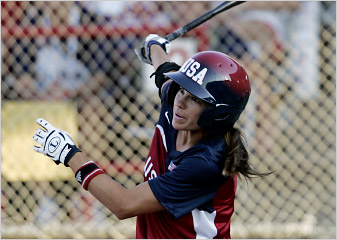
Since I last week gave a mini-rant about the sport and gender--how female athletes are represented in that their are either sexualized, passive, and looking "feminine" while playing sports (i.e. the beauty and grace-not strength-in tennis, the media and advertising images of female athletes), OR how they are distinguished from "proper" female bodies and their activities (i.e. the Sports Illustrated swimsuit issue), and how this is consistent with the way that women's accomplishments and skills are persistently assessed--I thought this was worth a nod. Via Feministe, the New York Times in reporting about female athletes used photographs of female athletes in action and on its front page. And not in grace and poise, but in raw strength and power of athletic activity.
Significantly, one of the stories was not even relating to a sport activity-the ideal opportunity to emphasize the beauty and femininity of the athlete over her athleticism. But they didn't.
This anomaly doesn't mean that sexism and heteronormative gender-production in sport doesn't exist. This isn't "proof" of any sort. Gender and sport (and I'm talking more about representation of women than participation of women in sport) is a big concern on mine, and I expect it is something I will continue to address.
But props where props are due.
And as Jill @ Feministe said,
I just keep repeating to myself: Baby steps.
Saturday, March 29
The Best Music Video I've Seen, like,..EVER
Wow, looks like this song isn't at all new, but it's new to me, and all I can say is...WOW. Very moving and very right-on. The only thing I would change is...the name. Because I would never say the girls who buy into the message that women are only as valuable and worthwhile as they are "sexy" and are sexually available are "stupid" (or the guys, as the vid is a critique on their significant participation in it too-after all, whose expectations is this all for?)...but somehow "stupid patriarchy" or "stupid culture" doesn't quite have the same ring to it. So WORD! to Pink. Smart is sexy, and I'd say she's right up there. So, eat this up!
(NOTE: nothing after the jump)
Tuesday, March 18
"Torture Porn" or Female Empowerment? Neither? Both?
Women's e-news has an interesting article about "torture porn" directors positing their work as "feminist." This descriptive category, coined by David Edelstein of the New York Times (and frequent Fresh Air film reviewer), refers to recent films such as Hostel and Captivity.
One part of the piece in particular struck me:
"Men are making films and calling them feminist when they don't understand the feminine experience," Soloway [a consulting producer of ABC's TV show "Dirty Sexy Money" ] said. "It's their salute to how they see female power."
I find this quite interesting and also don't doubt this is likely the directors' intentions. Isn't it interesting though to see what "power" means to these (male) directors and how it looks when taken up by a woman? But in their unproblematic and uncritical depiction of sex-violence, they don't see how both are gendered realities, and in women's daily lives are combined as a means of controlling and possessing women. This lack of contextualization makes their rendering of them more in collusion with gender-based oppression than fighting it.
Further, it leaves the idea of (masculinized) power and its role in maintaining racist, heterosexist patriarchy uncriticized. Women are depicted as powerful so long as they control the violence done to them (brutally done and graphically depicted) by violence of their own.
Lindsey Horvath, who works in film advertising and is president of the National Organization for Women's Hollywood chapter says, [...]
"Essentially I watched an hour and 45 minutes of a woman being stalked, drugged, nearly raped and terrorized," she said. In the end, the character escapes and kills her attacker. "It's like as long as the woman kills the guy at the end, then of course it's a female empowerment movie."
For the reasons listed above, I find the rationale that the eventual "triumph" of the female character overrides and makes unproblematic the rest of the depictions in a film unconvincing. The ends apparently justify the means. In a way, the sexualized violence throughout the film may also function to make palatable the fact that "the woman wins," that the woman takes control of herself back from (symbolic) masculine domination.
Further, I really have to doubt that people see movies like these because the woman wins in the end.
I must admit I am fascinated by the way gender and sexuality is produced in horror films. Some recommended reading from my reading "wish list":
The Naked And The Undead by Cynthia A. Freeland
Men, Women, and Chain Saws: Gender in the Modern Horror Film by Carol J. Clover
Also check out Ax Wound 'zine.
Thoughts?
UPDATE 3/20: Women's E-News writer Rachel Corbett has a more detailed discussion up at Alternet.
Keep Reading...


