A (humorous) reminder that women and black Americans (not to mention black women!) actually vote for who they think is the most qualified candidate-- shocker, I know. And what a f*cking insult that the media persists in insinuating they don't. And funny, no one appears to be asking white men voting for John McCain if they're voting their gender or race. Oh that's right, McCain gets to be an unmarked "candidate" while Senators Clinton and Obama are marked as sexed and racial 'others.'
via feministing
(Cross-posted to The Reaction)
Thursday, May 1
A Humorous Critique of Voting One's Identity
Wednesday, April 30
On Becoming a Sexual Female, via Miley Cyrus
I tend to agree* with this analysis of the photos of Miley Cyrus in Vanity Fair that we've seen so far from Vanity Fair, that they're not "that bad."
*sidenote: Except that the bare skin and sultry looks are for your prom friends, not the American Celebritocrical Gaze. And typically you go to the prom at 17-18, not the age of 15. Mir Kamin makes the distinction quite well between these images and simply wearing a backless dress:
For me, my problem lies with the fact that she's underage and I find the picture intentionally sexual. It's not her naked back -- it's her tousled hair, her come-hither look, and the bed-sheet-esque cover; all of those things together combine to portray a post-coital vixen.(end of side-note)
But the whole thing still troubles me for a few reasons I know, and probably some I can't articulate yet. And I think the question of whether the images themselves are "that bad" isn't the real issue here.
And I've really become disappointed in Annie Leibovitz who, back in the day, took this amazing image of Yoko Ono and John Lennon that surprised our gender expectations. She has recently become more known for replicating racist images of the recent past, and now this. And while, as I said "they're not that bad" (isn't is sad we have a world of sexualized teen girls to compare this image to that we can make the judgment, 'it's not that bad'? Ugh)
This comment on Female Impersonators is quite striking and right-on, and I think it sums up what was really giving me anxiety:
a fifteen year old girl should be beginning to discover her sexuality. She should understand how her body works and why. She should appreciate her body's feelings and responses, but she should not be doing it in front of the world. To sell magazine covers.That's exactly it. In a world where women's desirability matters more than her desire or that she desires at all, this is sad yet unsurprising. This 15 year-old girl is learning the very real and 'truth' of our modern culture that posing and being socially stamped as 'sexy' is an important (if not the important) part of women's 'sexuality'. That her being sexy is defined through, well, this. I'm not denying that a 15 year-old can be a sexual being. But the problem is that our culture perpetually defines sexuality and sexiness in terms of public validation of public sexual display. And hers being a sexuality-in-process...sigh. And what were you saying about 'The Sexual Revolution'?
And Gawker's provocative take on the photos is pretty interesting: grooming for pedophilia. I would never argue that's what is consciously and absolutely going on, but it's a compelling suggestion.
And it also makes me think about how our culture "grooms" women to become public sex objects, to desire the validation it provides, to justify it to themselves until it's "no big deal." We don't live in a vacuum, and women (or girls) don't one day jump out of bed and say "I think I'd like to show my tits to strangers while I'm drunk next spring break."
I think I'm just going to leave this here for right now. Thoughts?
Keep Reading...
Monday, April 28
The Next Steps for Redressing Unequal Pay
I don't normally blog on equal pay. It is for sure not an area of expertise. I did a short post two weeks ago for Fair Pay Day, because I was so struck by the tangibility of the day in April where men's and women's wages would be equal, and how that day is so close to Tax Freedom Day. But it really isn't an area I'm extremely knowledgeable about (as far as studies go), and I know that the notion of "equal pay" is often contested-- studies often come to conflicting conclusions, people often don't make their terms clear, and there are many different opinions as to who should get equal pay and what counts are equal pay.
These debates are not what this post is about. This is about the Fair Pay Act--the one that on the 23rd a motion to advance it was passed by a majority in the Senate, but didn't get enough votes to have a debate and vote scheduled on the bill itself. It's called the Lilly Ledbetter Act, and Suzanne Reissman has an excellent explanation about the history of the bill and what this bill is actually about--check it out here.
Regardless of whether you 'believe' that pay discrimination as a result of sexual identity exists or not, there is no reason not to support this bill--because the bill addresses the terms by which pay discrimination can be redressed--and if there is no pay discrimination, then the law won't need to be utilized!
The next steps for advocating this bill is to contact your Senators. See the National Women's Law Center for more information on pushing your Senator to get a debate and vote on the bill scheduled.
Friday, April 18
Fair Pay

It kind of reminds me of Tax Freedom Day, the day that the nations has earned enough income to pay our tax bill. Funny, though--(federal) Tax Freedom Day is April 23rd (although this varies by state, mine in New York isn't until May). That tends to make people pissed--realizing they work 4 months just to pay their government taxes.
But women have to work an extra 4 months to equal what men are paid yearly, which is about the same amount of time "Americans" have to work to pay their tax bill. Thus, , from a conceptual point, the difference in men's and women's pay is about the same as the amount of taxes paid by the "average" American. Think about that for a second. Or several.
Then write in your support for the fair pay act, and encourage others to do the same.
cross-posted to The Reaction
WOMEN: Please consider participating in Esquire's Survery
Via WIMN's Voices: This is not to endorse Esquire at all, but they are wanting to hear from real, actual women the answer to one question: What is something that men don’t know about women?
Since I am one who loathes men's magazines and does not cease in perpetually critiquing their phallocentric approach to het relationships with women, this seems like something women ought to participate in. Since, ya know, they're actually asking. Not that I have a ton of faith in accurate reporting, but hey, it's worth a try, yes?
Read the info at the WIMN's Voices link above. Think about it, and make your response articulate and meaningful.
Mother-daughter bonding over waxing? At age 8 ?!?!
First, a really good article at blogher by Mir Kamin about the new trend of mothers taking their 8 year-old daughters to spas...to get bikini waxes. Seriously.
She quotes the fuck shaving livejournal community, where one person commented:
I thought these were great points. Daughters need their fathers and brothers reiterate their personal value beyond their physical appearance. Even more, fathers need to not be hypocrites when it comes to valuing women, having a complex and meaningful ideal of beauty and sexuality, and assigning a health place in life for appearances. Children pick up on non-verbal and implicit cues more than we think. Mothers need to bond with their daughters in ways that don't feed the patriarchal capitalist beauty machine. Girls should not be sex-objects-in training, despite what synonyms thesaurus.com gives for "girl."It's sad that all these moms can't think of anything else to do to bond with their daughters but go to the spa. What about taking a walk every evening to talk about their day, or cook together, or take up art classes or fucking something else.
[...]
Also, do any other these daughters have fathers? Do any of these women have husbands?
Don't they have some influence in their lives telling them that they're beautiful no matter what?
Philadelphia Magazine had a nauseating article about the spa happenings of the pre-teen rich and famous, enabled by the moms and the almighty dollar-greedy beauty industry.
Melanie Engle was trying to just pluck the stray hairs here and there. She was trying to deliver an age-appropriate eyebrow wax to her client. It was hard, though, because there was a foot tapping next to her, and a voice shouting in her ear: “No! Not like that — like a supermodel’s. I want them arched.”Indeed. And I found this particular part to be especially interesting:
...
“It’s like, ‘Okay, you’re becoming a woman now, here are the things you’ll need to do as a woman.’”
Except, of course, they’re not women. This new, unstoppable desire of mothers to pluck and paint their daughters has created an unexpected conundrum for spa owners and aestheticians, who can’t afford to lose the moms’ lucrative business — but who also don’t want to be partners in crime.
...
The world has changed since my ’tweendom. Look at the media, and its obsession with fame, beauty, youth, celebrities, debutantes, celebutantes. It’s in our faces all the time. It’s in our kids’ faces, too. “It’s like this keeping-up-with-the-Joneses thing has stretched to our kids,” says Dasha Klein, a Main Line mom of an 11-year-old girl at Baldwin. She knows multiple teenagers who’ve gotten boob jobs for Sweet Sixteen presents, and a 20-year-old who gets Botox. “Except they’re trying to keep up with Hollywood — and Britney Spears and Paris Hilton and Miley Cyrus and whoever else they’re looking at. Well, guess what? You’re in Philadelphia. And you’re a kid. You’re not Angelina Jolie.”
When I was in my teenybopper heyday, there were no pop chicks who I aspired to be. There were boys I aspired to marry. The media world surrounding us made us boy-crazy — maybe not a fabulous thing for a 10-year-old, but at least it didn’t lead my friends and me to inject botulism into our foreheads before we could legally drink. It was innocent: We giggled, swooned, hung posters of Joey Lawrence and Luke Perry, giggled some more. And our moms were … uninvolved. They didn’t drop us at the playground with instructions to bring home the boy who looked the most like Kirk Cameron. They rolled their eyes, bemusedly shaking their heads as they passed by our rooms: Oh, you silly girls. End of story.When I read this, I thought: that's it! Recently especially I have been struggling to recall what my 10-16 years were like. All I can seem to come up with is that they are nothing like the pornification of girlhood right now. But the author's point really resonated with me, and from her boy-crush examples, she is probably around my age. When I was younger, reading Teen and Seventeen, there was a much greater emphasis on the "cute boys" in your fave sitcoms. And the Preferred Stock model, Joel somebody-or-other. As the writer says, that isn't necessarily something to glorify, but it is quite distinct from what's happening now: there was indeed more a focus on girls' (teen) desire, fantasy, and imagination. The focus was less on making yourself the perfect porn-star object of desire. Now, the focus seems to be more who to look like, not whom to look at. It's a matter of passivity vs. activity, objectification vs. agency, self-scrutiny vs. desire. It's what feminism has tried so hard to steer against. And somehow more opportunities for girls self-development has been co-opted and become the freedom...to get bikini waxes at age 12. And pleasure has become derived from being pleasing rather than being pleased. At this is where is begins.
Not anymore. Today’s girls aren’t looking at posters; they’re looking in the mirror. They have a new obsession — a self-obsession — and it’s being aided and abetted by their mothers. “It’s like this focus on their outer life is trickling down to their daughters,” says Rescue’s Albert. These women have to look a certain way, so inevitably, their young daughters, still under their control, do, too.
This should be a wake-up call for us. Unfortunately, it has all just become part of the game.
Oh, and this I just read about, and I don't know what to do with it...via Jezebel, "a plunging padded bra for 7-to-8 year olds." Seriously. And to connect this back to my growing-up years too, as adolescents, we were embarrassed about our bodies, and I don't think that was a good thing. At all. But it's interesting how attitudes have swung to the opposite end of the spectrum, yet still has not yielded a more substantial notion of sexual independence and autonomy. It's a "yes, but..." kind of situation, where yes, we do (have more 'autonomy'), but in our (still sexist) society, women's sexual independence still gets defined by (self) objectification and her value for-another. Are we (as women) able to have sex more freely than we used to? Yes. Does this mean society has achieved "sexual liberation"? Nope. Sexual "liberation" through a culture obsessed with visual sexuality (or being visually sexual) has been bought with socio-cultural (although not legal) sexual regulation. That's all I'm going to say on this now...but more to come on this topic.
further reading: History of Sexuality by Michel Foucault, Female Chauvenist Pigs by Ariel Levy. (both in my Amazon picks)
Keep Reading...
Wednesday, April 16
What's wrong with this article? Marriage and Taxes, part 2
Especially in light of my critique of 'marriage'-centric social organization, check out this article from CNN.com:
"Study: Single parents cost taxpayers $112 billion":hmm...what's wrong with this so far? (hint: it's something to do with the premise of the article)
Divorce and out-of-wedlock childbearing cost U.S. taxpayers more than $112 billion a year, according to a study commissioned by four groups advocating more government action to bolster marriages.
Ok, I'll tell you.
- It implies that divorcees and parents who are unmarried are not 'taxpayers.'
- Thus, it positions those not divorced or single parents--married people, single people (aka not-yet married), and married parents--as the 'ideal taxpayer-citizen'
Next:
Sponsors say the study is the first of its kind and hope it will prompt lawmakers to invest more money in programs aimed at strengthening marriages.Could it possibly be that our social and economic structures heavily favor married parenting, and that's what needs to be investigated, rather than 'strengthening marriage'??
Two experts not connected to the study said such programs are of dubious merit and suggested that other investments -- notably job creation -- would be more effective in aiding all types of needy families....which is good, especially since I heard on NPR recently (I can't find the show reference! aah!) that divorce and income are correlated (and ya know, 'the sanctity of marriage' etc. is of utmost important to preserving 'traditional' --read: patriarchal capitalist --values).
There's more:
Scafidi's calculations were based on the assumption that households headed by a single female have relatively high poverty rates, leading to higher spending on welfare, health care, criminal justice and education for those raised in the disadvantaged homes.Right, because there's a natural connection between single mothering and poverty, apparently, so we need to fix the 'single mothering' rather than, say, the 'feminization of poverty' or the socio-economic structure that perpetuates single-parent (mother) poverty.
See, there's two problems here with our socio-economic structure:
- The assumption of two parents present and sharing a home. The model used to be male breadwinner/female domestic servant. Now, women are 'allowed' to have economic independence but continue to bear the homemaking burden.
- Women are paid less money, plain and simple.
At the end of the day, the article--along with the study and those who commissioned it--assumes the natural and neutral center of American life (ought) to be marriage and specifically, married-parenting. Further, they conclude that we should tell people how they should structure their networks of association in their life because it would cost less in government expenditures and because they are deviating from some sort of arbitrary 'normal'. Sure marriage is the norm in American society; that doesn't make it natural. It's still an arbitrary primary structure of social relations.
Sure sounds like life, liberty, and all that jazz to me!
cross-posted to The Reaction
see my part 1 here
Keep Reading...
Tuesday, April 15
Badu's Advice for Female Music Artist-Hopefuls is Great Social Commentary
Terrific tongue-in-cheek 'advice' from a wonderful, respectable, talented, independent, kick-ass female music artist. Her words speak loads. via 5 Resolutions
Friday, April 11
Thesaurus.com Says 'Female' is Equivalent to 'Weaker'
Both feministing and Jezebel reported this week that a Thesaurus.com entry has shown up for the word "weaker" where the only two entries are "female" and "lady." The entry has been removed so you can view the screenshot here.
My guess is this was supposed to be some sort of a joke, since not only have those two synonyms been removed, but if you look up "weaker" in Thesaurus.com, there is no entry for it, period, only for "weak." From looking at the site, though, it doesn't seem to be user-generated so if it was a joke, it was an "inside" one or a hacker--I hope.
Not only am I bringing this up because it is so blatantly sexist, not to mention completely unproductive, say for a student needing a real synonym, but because this connects a great deal to my previous post about gendered-language and the denigration of the female that is encapsulated by the term pussy, but also because language politics in terms of gender/sexuality has been popping up in the news. A couple weeks ago, weakness was aligned with femininity in the recent commentary on Obama's bowling performance, and Christopher Hitchens' characterized (gay male) Andrew Sullivan as acting like a 'lesbian' in order to insult him.
This Thesaurus.com incident proves how deeply embedded these associations are in our culture-- whether it goes to show that woman is "officially" connected to the meaning of "weak" or that a hacker understood this cultural connection and attempted to embed it into institutional discourse.
The synonyms they provide for the "weaker" synonyms "female" and "lady" are seems to be taken from the actual entries for various woman-related terms. And as long as we're talking about language and thesaurus.com, lets do some word analyzing.
"female":
noun-amazon, babe, beauty, broad, cutie, dame, doll, dowager, duchess, femme, filly, fox, gal, gentlewoman, girl, lady, madam, mama, matron, petticoat, pinup, seductress, she, siren, sis, skirt, temptress, tomato, wench; adjective-changeable, child-bearing, delicate, effeminate, effete, fair, feminine, fertile, gentle, girlish, girly, graceful, ladylike, maidenly, matronly, modest, muliebral, oviparous, petticoat, pistil-bearing, pistillate, pure, refined, reproductive, sensitive, she-stuff, shy, soft, tender, twisty, virgin, vixenish, weak, womanish, womanlike
vs. "male":
noun- ape, beefcake, boy, bruiser, buck, bull, chap, dude, father, fellow, gent*, gentleman, guy, he, he-man, hunk, jock, john, macho man, papa, stud, tiger, tom, wolf; adjective-macho*, manful, manlike, manly, potent, virile
Notice anything? Perhaps an emphasis on sexual appeal in terms of being female and sexual action in terms of being male? Perhaps mostly terms of confidence, self-identity, and positivity for male while female terms are largely relational (not individual), object-like, or negative.
Looking closer at these listings for each...
So how about looking at "girl":
babe, baby doll, bird, blonde, bobby-soxer, boytoy, broad, butterfly, canary, chick, coed, cupcake, cutie, dame, damsel, daughter, deb, debutante, doll, female, filly, gal, jail bait, lady, lassie, mademoiselle, maid, maiden, minx, miss, missy, mouse, nymph, nymphet, piece, queen, schoolgirl, she, sis, skirt, spring chicken, teenybopper, tomato, tomboy, virgin, wench, witch, woman
vs. "boy":
buck, cadet, chap, child, chip, dude*, fellow, gamin, guy, half-pint*, junior, lad, little guy*, master, punk*, puppy*, runt*, schoolboy, shaveling, shaver*, small fry*, sonny*, sprout*, squirt*, stripling, tadpole*, whippersnapper*, youngster, youth
Looking at the girl/boy listings, of which there were 50+of each...
You might be thinking, "it's just Thesaurus.com...what's the big deal?" Well, Thesaurus.com and Dictionary.com are heavily used and are considered reputable sources. And words mean things. Language shapes thought, and what we are able to think. So long as we overload terms for female with passivity, sexualization, objectification, and motherhood, and male with activity, active sexuality and prowess, we will continue to think of men and women in these terms. Think about it--what do we call a woman who's sexually active--slut, loose, whore? What do we call a passive male sex object? Um, hunk...maybe? Or meaty? And of course juxtapose those terms with "delicate," "weak," and "sensitive," and maybe now we're seeing this isn't just an issue of a word or two.
And when "mama's boy" is an anomaly of "boy" while "tomboy" is part of the definition of "girl," we have some serious heteronormativity in our language. And when nymph and virgin, doll and cutie are the way we think of young girls rather than simply being not-yet women, some light is shed on our incredible social problem of girls' sexualization and the sexualization of the young and vulnerable (even if legal) in general. And why is there no term for an intelligent girl, like we have for "boy wonder"....just "cover girl"?
When we can't think without words, when we understand that words do not simply reflect our thought but actually shape it, we can begin to understand that they're not just words.
*for more of the same, check out dictionary.com for "woman" and "man."
cross-posted to The Reaction
Thursday, April 3
Great NPR Commentary on "Horton" and gender
Living in Canada, I listen to NPR online when I can. Almost every show is available online and you can listen at any hour. I love NPR. And I love Peter Segal, host of "Wait, Wait, Don't Tell Me!" their weekly news quiz show with a panel of known comedians (such as PJ O'Rourke, Mo Rocca, and Paula Poundstone) where you get rewarded for your current events geekdom (which used to be called "civic engagement") with being able to laugh at the jokes.
So check out this great (and quick!) commentary from Peter Segal on how the revised plotline of "Horton Hears a Who" is just the same-old Hollywood gender shaping. Nothing better than a father (of girls) genuinely pissed off at the flat representations of them in movies.
My favorite part:Have the clowns who made this movie ever met a daughter? Have they dated one? If they did, did they meet the daughter's father? Did they then ask that daughter's father if there was anything more dramatic, interesting, arresting, and moving to him than his relationship with his daughter? Did they ask him if he might find that a close relationship with said daughter might be something he would care about? What do they imagine that we do — sit around, and watch our daughters grow and change and suffer and fail and triumph — and idly wish for something more INTERESTING?
And while you're at it, check out Dads and Daughters.
Tuesday, April 1
Positive Sports Reporting
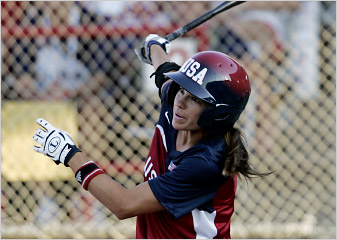
Since I last week gave a mini-rant about the sport and gender--how female athletes are represented in that their are either sexualized, passive, and looking "feminine" while playing sports (i.e. the beauty and grace-not strength-in tennis, the media and advertising images of female athletes), OR how they are distinguished from "proper" female bodies and their activities (i.e. the Sports Illustrated swimsuit issue), and how this is consistent with the way that women's accomplishments and skills are persistently assessed--I thought this was worth a nod. Via Feministe, the New York Times in reporting about female athletes used photographs of female athletes in action and on its front page. And not in grace and poise, but in raw strength and power of athletic activity.
Significantly, one of the stories was not even relating to a sport activity-the ideal opportunity to emphasize the beauty and femininity of the athlete over her athleticism. But they didn't.
This anomaly doesn't mean that sexism and heteronormative gender-production in sport doesn't exist. This isn't "proof" of any sort. Gender and sport (and I'm talking more about representation of women than participation of women in sport) is a big concern on mine, and I expect it is something I will continue to address.
But props where props are due.
And as Jill @ Feministe said,
I just keep repeating to myself: Baby steps.
Thursday, March 27
Musings: Struggling to Share What/Who Feminism is For
Salon's Broadsheet has this recent article: "Welcome to the 'Menaissance'", which, I have to say, struck me kinda funny...but also sad. It also struck a chord for me in light my recent thoughts pondering how people can take feminism so...wrong, especially when it's something I have lived and breathed for the past 10 years, and what has fundamental to my understanding my experiences, others' experiences, and the world around me. For a sample of men allegedly enamored with stereotypical masculinity, they're awfully whiny. Women are fairly familiar with the pressure to be "waxed and coiffed," living by men's rules and struggling to balance family with work. These men do, indeed, seem burdened and resentful, but to them, I say: Welcome to the party!
I have been cruising around the blogosphere lately, and seen in abundance the incredibly angst that many men feel toward feminism. Clearly, feminism has ruined their life. It took away their housekeeper, it has subjected them to sexual activity that doesn't revolve around their needs, it has meant legislation and social policy that doesn't take men's experiences for human experience; women's economic independence has meant they men can no longer expect to be able to provide for a woman in exchange for control over her body and labor, and it has also meant that economic security is not enough to gain access to women at all.
And let me tell you, some men are really pissed. And say it's feminism's fault. And when women behave badly? Also feminism's fault. They fail to see that an analysis of gender as a hierarchical institutional system of oppression is not just about women's rights, but about analyzing society to reveal how the structure is harmful to all involved, but that equality often also means giving up some privileges. Women's rights, however, often get rewritten as "special rights and advantages," because from a man's perspective, it might look that way because they are accustomed to seeing male-centered society as just "society." The work structure that follows from men's needs is seen as just "the workplace." Men then end up resisting feminism, viewing it as advocating female dominance rather than see it as liberating masculinity as well as femininity.
I suppose I'm rambling on a bit and being vague, but I'm doing that a bit on purpose because I'm not trying to accuse or blame any particular individuals or websites. But I have had an interesting few days observing the way that many men perceive feminism-they perceive it as threatening (which is it-to structural male privilege), but in articulating their frustrations (and often rightly so) about their masculine gender role/expectation, feminism, and not patriarchy, is blamed. And it really is too bad. I've tried interacting with some of them, and let me tell you it's really tough to break all these assumptions about what feminism is and what it isn't, and articulating bad behavior that some women exhibit toward some men vs patriarchy as a cultural system of privilege. Not to mention that feminism does not advocate women's bad behavior-women, for example, lying about being raped! Yet feminism gets blamed for this (because feminism created rape, I suppose, since it suggests women can say no if they don't want sex. Or because feminism I guess teaches women to use whatever they can to their advantage).
We're all concerned with young women not wanting to embrace the term 'feminist' because of much cultural misunderstanding. I think that problem is easier to address (by tangibly addressing real-life issues like Jessica Valenti does in her book) than how do we show men that feminism is their friend? That much of what they attribute to feminism is really a result of patriarchy? How do we convince them that it is worth it to give up some privilege in order to live safer and more meaningful lives?
Back to the Broadsheet article:
While I don't necessarily say welcome (although in some cases I do), it's funny how these struggles are seen to be a result of feminism's challenge to gender roles, therefore a reversion to traditional masculinity is seen as the solution, rather than the problem. I think men's anxieties are very real and are surfacing now because the way we typically think about gender and sexuality has changed as a result of feminism and queer movements, and these changes and challenges bring into relief how traditional masculinity was predicated on a particular form of femininity and organization of sexuality.
So I don't want to welcome men into women's struggles with patriarchy, except to hope their struggles might become the ground on which to be able to say, "I advocate feminism."
(the inclusion of this video is not to imply that The Feminist Majority speaks for all feminisms or all women)
Wednesday, March 26
Taco Bell Promo: Problematic? Yes. Misogynistic. Not Really.
Feministing recently posted about a new Taco Bell Promo, calling it "misogynistic." Since then I've seen a bit in the anti-feminism segment of the blogosphere, up in arms because "the feminists are at it again!" bitching over nothing because our abundant gender equality makes it so we have nothing else to complain about.
To be honest, I didn't think the ad was misogynist (as in perpetuating woman-hate), and I just moved on to reading the next feministing story. But me not classifying it as misogynistic doesn't mean it isn't deeply problematic.
The whole promo is this: you can "pretend" you are a fashion photographer by taking still images from digital video footage of a model on location (who happens to be in the current SI swimsuit issue, to be discussed further down). Yes, you read it right. It's really that stupid.
But, it's also problematic.
This report from MarketingVox hits the nail on the head:SI and Taco Bell promoted the site with online ads on MTV.com and ESPN.com, as well as other sites with a large male audience.
Why don't they allow the winner to have a choice of model?, you ask. That would make sense to me. But that would presume that the promo is actually about the interactive activity on the website. But it's about corporate sponsorship. The problem is that the promo is sponsored by none other than Sports Illustrated, who invests more money and energy in promoting (non-athletic) women's bodies for visual consumption than in proper news coverage for female athletes. The mere existence of the swimsuit issue from a sports magazine (!) reminds us that the appropriate culturally-sanctioned use of women's bodies is not athletics, not strength, not aggression, not speed, not size, not bulk, but is being a sexually desirable object, that's small, that doesn't take up too much space, that is passively sprawled out for display, and one that is always, always available
But the Taco Bell promo is not about being able to photograph a model. It's about sponsorship revenue from a "Sports" news magazine that can't seem to realize that strongly advocating women as sex objects for the heterosexual male viewer, the consumer of choice, has no place in a magazine that is supposed to be about sports-women's and men's sports, with readers who are female and male, heterosexual and queer, white and people of color.
No one needs to apologize for finding women attractive, and this criticism does not suggest that finding a person attractive is wrong. But the problem here is the assumption that (straight men) are the center of the world and that women's bodies alone are the ubiquitous symbol of sexuality and beauty. And that's what needs apologizing for.

Subscribe to:
Posts (Atom)


