NEW BLOG ADDRESS

By the end of Sunday May 4th, I will be switching my blog hosting from Blogger to Wordpress. My new blog address will be:


If you read this through a feedreader or email subscription, those subscriptions will be transferred over to the new blog. If you bookmark this blog or blogroll it, please update your listings.

Monday, April 14

McCain defends masculinity by resorting to sex-based insults

OK, so this has been mentioned everywhere, but in The Real McCain by Cliff Schecter, he claims that McCain responded to his wife's comment about his hair thinning by calling her a 'cunt.'

From the book, via Feministing:

At one point, Cindy playfully twirled McCain's hair and said, "You're getting a little thin up there." McCain's face reddened, and he responded, "At least I don't plaster on the makeup like a trollop, you cunt." McCain's excuse was that it had been a long day.
For the record, trollop means "prostitute" or "promiscuous woman."

(Interestingly, dictionary.com phrases this to imply that a prostitute is a particularly promiscuous woman, as if prostitution as sex work and individual promiscuity for one's own pleasure -not work- are in fact conceptually related).

See my previous posts on sexed bodies and gendered insults, and on gendered language more generally.

No further comment required.

Keep Reading...

Sunday, April 6

The More Things Change...

The more they stay the same...

Check out these advice nuggets from 1950's mags. Sound familiar? Via F-Word.org: Food, Fat, Feminism.

And here's a snippet from Jean Kilbourne's Killing Me Softly 3 that I found on Youtube. She's been doing research about media imagery and women's sexuality and identity for 30 years. And it's pathetic how much things don't change. I recommend checking out her film (in lots of libraries!) and her book, Can't Buy My Love (in my Amazon book picks).


(NOTE: nothing more after the jump)

Keep Reading...

Thursday, April 3

Great NPR Commentary on "Horton" and gender

Living in Canada, I listen to NPR online when I can. Almost every show is available online and you can listen at any hour. I love NPR. And I love Peter Segal, host of "Wait, Wait, Don't Tell Me!" their weekly news quiz show with a panel of known comedians (such as PJ O'Rourke, Mo Rocca, and Paula Poundstone) where you get rewarded for your current events geekdom (which used to be called "civic engagement") with being able to laugh at the jokes.

So check out this great (and quick!) commentary from Peter Segal on how the revised plotline of "Horton Hears a Who" is just the same-old Hollywood gender shaping. Nothing better than a father (of girls) genuinely pissed off at the flat representations of them in movies.

My favorite part:

Have the clowns who made this movie ever met a daughter? Have they dated one? If they did, did they meet the daughter's father? Did they then ask that daughter's father if there was anything more dramatic, interesting, arresting, and moving to him than his relationship with his daughter? Did they ask him if he might find that a close relationship with said daughter might be something he would care about? What do they imagine that we do — sit around, and watch our daughters grow and change and suffer and fail and triumph — and idly wish for something more INTERESTING?
And while you're at it, check out Dads and Daughters.

Keep Reading...

Tuesday, April 1

Positive Sports Reporting

Since I last week gave a mini-rant about the sport and gender--how female athletes are represented in that their are either sexualized, passive, and looking "feminine" while playing sports (i.e. the beauty and grace-not strength-in tennis, the media and advertising images of female athletes), OR how they are distinguished from "proper" female bodies and their activities (i.e. the Sports Illustrated swimsuit issue), and how this is consistent with the way that women's accomplishments and skills are persistently assessed--I thought this was worth a nod. Via Feministe, the New York Times in reporting about female athletes used photographs of female athletes in action and on its front page. And not in grace and poise, but in raw strength and power of athletic activity.


Significantly, one of the stories was not even relating to a sport activity-the ideal opportunity to emphasize the beauty and femininity of the athlete over her athleticism. But they didn't.

This anomaly doesn't mean that sexism and heteronormative gender-production in sport doesn't exist. This isn't "proof" of any sort. Gender and sport (and I'm talking more about representation of women than participation of women in sport) is a big concern on mine, and I expect it is something I will continue to address.

But props where props are due.

And as Jill @ Feministe said,


I just keep repeating to myself: Baby steps.

Keep Reading...

Sunday, March 9

Another interesting perspective on patriarchy hurting men

I've been a little more MIA lately than I intended to be. I had a week off from class at the end of February and went to New York City, and now I'm getting into the busy time at school when I have to start thinking about my course paper and am feeling the pressure of writing my thesis....

So here's a quick post about another post and comments to it that I found interesting.

Posted on Shakesville, "Robbing the Hearts of Men" is speaking about patriarchy hurting men. It's an excellent read, along with the comments on the post.

A few of my thoughts (and I commented on it as well):


  • I was immediately put off by her article at the beginning when she says:

It's long been my view that sexism and misogyny do every bit as much damage to men as to women.


I do not agree with this. Like one commenter says,

I do not think "sexism and misogyny does every bit as much damage to men as it does to women." If it did, they would stop it. Damage, yes. "Every bit as much damage" seems to me to be a stretch too large for reality to encompass.


The next commenter indicates why men being damaged by sexism is often hard for men to see or want to do anything about-this damage comes from a system that advantages (white) men. while in many ways they are hurt by it, there are many more ways (or perhaps more tangible or rewarding ways) they are privileged by it.

Perhaps there is a kind of sub-conscious cost-benefit analysis going on here-certainly women who yearn for traditional gender roles or who demand a man to take care of her do the same thing. In fact, attitudes don't need to be even as retro as that-there are many ways that women choose "the path of least resistance" (please! read The Gender Knot by Allan G. Johnson) by "using" patriarchal attitudes to their advantage instead of fighting them-many uses of "sexuality" to "get what you want" can fall under this category.

Another commenter made this interesting point,

I think many men aren't fighting to undermine the patriarchy not because they support it or hope to benefit from it, but because they literally don't understand it's there. The world is set up for them, it seems to run fine, why can't everyone else adapt?

It takes actually stepping outside oneself to recognize the level of privilege men have. Now, needless to say, some men are aware of that privilege and are happy to defend it. But many who are opposed to feminism are actually opposed to strawfeminism, many are opposed to "man-hatin' humor," which isn't part of any feminism I've seen, and many are afraid of change because they're just afraid of change.

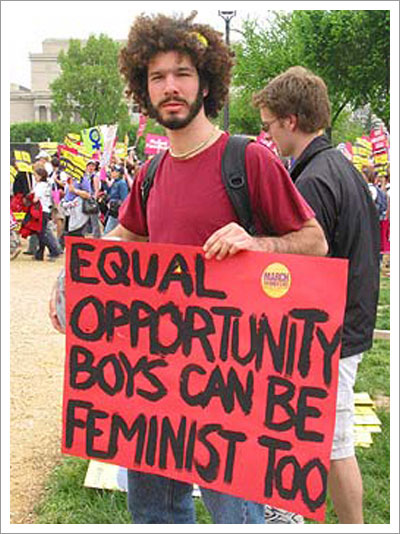
True, true. There needs to be some way to educate men about feminism and gender analysis. There is the awful assumption that feminists hate men. Many feminists like men an awful lot, they just hate patriarchy. And it can be hard for men who feel like women want to "take away" "their" privileges to see how they are hurt by patriarchy and how its critique can benefit them. then there's also that darn cost-benefit thing which keeps many men from embracing feminist critique.
  • Another concern I had is the way that what she deplores (emotional men denigrated as feminine and therefore men are taught not to experience a range of human emotions) does not seem to be part of the feminist/gender analysis of the social construction of masculinity and femininity, which it most certainly is. She says,
In our society (at least), the following traits are considered primarily "female/womanly":
Tender, Emotional, Vulnerable, Receptive, Passive, Compassionate....

...If you are living in a misogynist, sexist society where privilege is awarded automatically by virtue of manliness/maleness or perceived manliness/maleness, and therefore, being womanly/female is an undesirable (if not despicable) position, then you are going to work hard to avoid the culturally-acceptable traits of womanliness...

...Men feel -- because they're human. They experience moments of tenderness, and vulnerability, and emotion (yes, emotions other than rage) -- as well as moments of compassion, and receptivity, and passivity.

The problem is: They can't express that without looking like a woman. Which, in a sexist, misogynist society, would be a bad thing. A thing that loses you jobs, and gets you called "pussy", and "mangina", and subjects you to suggestions that you "sit to pee" -- which would all be BAD, because being anything like a woman/female human is BAD.

This is exactly what the feminist critique of gender entails-both that what has been traditionally labeled "feminine" has been denigrated in order to support patriarchy and sexism, and also that there is nothing inherently bad or gendered about these attributes. Masculinity and femininity are not two separate social constructions where you can critique one without the other. consistent with a deconstructive analysis, masculinity is not self-defined-it is defined by what it is not: feminine. So to critique the arbitrary production of femininity and the subsequent denigration of all things female is to also critique masculinity. In this example there are many "wrongs" here-the idea that certain traits are considered "bad", that those "bad" traits are arbitrarily linked to a particular gender by arguing a natural connection, that this gender is denigrated all over society, that anyone in the dominant gender who exhibits said traits are denigrated as well...(see my post on the politics of the word pussy)

Now many female feminists do not necessarily write extended analyses about masculinity, but there are many male feminists who do, and they are well worth reading. (see my earlier post).

Keep Reading...

Monday, February 18

How sexism works

I've seen this cartoon in a few places today, but it is very true, and worth a few thoughts.

(feministing.com's headline for this was brilliant, "Boys suck at logic, non-sexism."

Sexism turn attributes of people into attributes of gender. Senator Clinton (I refuse to call her the demeaning "Hillary" as if she were Britney or someone) becomes a poor candidate because she seems like a "bitch" or her expression of emotions are read as "weak" or "manipulative"; if done by a male candidate they would have been read as "caring" (remember Bill Clinton?). Further, the authenticity of her tears was questioned since she, of course, comes off like a cold, hard, bitch.

See a bad driver? When it's a woman, the comment is often made, "women are such bad drivers." If the driver is a male do we then say "men are such bad drivers"? Does anyone really keep a tally of the quality of drivers by gender vs. the proportion of the driving population they consist of? And really, does one person's set of observations really produce a truth?

No it doesn't-but experiential "evidence" like this is meant to reinforce what we already think about particular identity groups. In the philosophical arena, "direction of fit" is when what we think about the world fits the facts of the world. In the feminist critique of epistemology, we see that this idea doesn't really happen, because the facts we recognize are those that reinforce what we already think about the world-we see in the world that which confirms what we already believe, and the mere observation of it in the world serves as "proof" of the truth of said belief. Think about it: it is so much easier for people to believe a "scientific study" that confirms "common sense" than one that defies it.


But science has been used for centuries to reinforce ideological views about the inferiority of races (non-white), ethnicities (non-Euro), gender (non-male), and sexualities (non-heteronormative), using their "facts" as "proof" of their discrimination and oppression. Much of the "old" science has been refuted, although many of their claims persist as "common sense." Indeed, sexist and racist views continue to be circulated in contemporary scientific studies.

Let's go back to the driving example-all this is to say, have you ever considered that in our society, despite what we think is our "gender equality," and regardless of whether she holds a paying job (versus the unpaid work of mothering), women disproportionately bear the burden of child-raising and rearing? Thus, if you do happen to notice that women drivers seem to be "bad," did you ever look to see if there were kids in the car, screaming for her attention? Did you ever think she was trying to make doctor's appointments and decide what to make for dinner while she's driving from work to pick the kids up from the sitter's? IF, and that's a big IF, women are "worse" drivers, could it actually be because of the prevalence of sexism that causes these things and not because of the "fact" of them being female? This just adds sexism to sexism. Perhaps it is better said that "people with young kids in the car are bad drivers."

This is the same thing that happens in the math example. IF indeed boys score higher than girls on math exams, it is wrong wrong wrong to say that because we are "gender-equal," (and that's up for debate in my book) that means boys are better than girls at math. Don't blame girls for continued gender discrimination in the classroom, from parents, hell, in the McDonald's happy meals, where the kinds of play and developments tools we give to kids will highly inform their capacities for certain academic subjects. Of, if a person's not good at math, maybe they're just not good at math. Blaming it on their gender is just as logical as blaming it on their eye color.

I think the appropriate saying here is, "you find what you're looking for."

And that's sexism for ya.

Keep Reading...

Friday, February 15

Msn.com/hotmail.com reiterations of gender stereotypes #1

I have really been taking notice recently of the relationship and lifestyle articles on both msn.com and hotmail.com. I have particularly been interested in the way the articles' language and placement serves to produce and perpetuate gender stereotypes and traditional gender roles in articles which are of "popular" interest and oftentimes can be read as reiterating "common sense." However, these light, shallow, common-sensical articles are replete with assumptions about gender and sexuality, and can be read with a critical eye as a backlash against feminism and progressive notions of gender and sexuality.

One the one hand, msn.com isn't really high-quality or insightful reading, so it a) really should be "no big deal" and b) it's non-progressiveness should be assumed. But, on the other hand, it seems that it is exactly these kind of pop-cultural artifacts than normalize our behavior and reiterate sexist assumptions in often subtle ways. Sometimes what seems the least serious of all is what we should be taking more seriously. Since this is quite a trend I have noticed on these sites, and considering the ubiquity of hotmail e-mail addresses and therefore incredible exposure to these "news stories," I think they deserve some attention and critique.

Therefore, I present part one in the series, Reiterations of Gender Stereotypes in msn.com and hotmail.com:


From today's hotmail.com articles (when you log into your hotmail account): an article titled, "Subtle ways to be sexy everyday"

From the intro:

  • More than anything else, sexy is a state of mind, and it starts with you! It’s a feeling that’s all about being warm, inviting and approachable, while maintaining a little bit of mystery. But most importantly, it’s about being confident and comfortable in your skin, and your clothing. So put the idea of the "bombshell" aside, ladies. There are plenty of understated ways for you to feel flirty every day.

So on the positive side, being sexy is about being confident in and comfortable with yourself-this is a good thing! But we also find out that this is something the "ladies" should be concerned with. Hmmm, not so good.

So what are some suggestions toward feeling comfortable and confident in yourself? Well, performing for a male spectator of course, but performing while looking like it's effortless!

  • ...your most intimate layers and mini makeup tricks will work wonders toward altering your attitude. Hot hosiery and sexy shapewear are items that are meant to make you feel feminine and fierce — and also excite your guy! Hints of red on your nails or lips are likely to stir up flirtatious feelings...And finally, perfume peaks the sense of smell and makes an invisible seductive statement that will linger in a man’s memory.

Geez, this doesn't sound like being "comfortable in your own skin", it's more like creating a "skin "that has been culturally-approved as sexy so that you can then feel comfortable! Here we also find out who the real target of "sexiness" is-it's about exciting your guy! It's all for someone else, not about being confident...unless such confidence is coming from conforming to the social/sexist dictates of female sexiness. Here is also where the heterosexist bias of the article comes in-because no woman who wants to be sexy could possibly be sexually interested in a woman!

  • ...disarm yourself by dressing in light, delicate colors such as blush and cream. Slip on sensuous-feeling fabrics such as cashmere and silk that conjure up images of cuddling and caressing — something that says sexy in a subtle way! Sheer peek-a-boo effects with a sleeve or thin overlay, and feminine details such as a flirty slip exposed at the hemline, hint at something to be explored later on.

To be sexy, a woman must be feminine-delicate, soft, an object of sexual desire (rather than the active pursuant of it). Yawn.

  • The girl next door is a classic symbol of sex appeal, and this look is easy to accomplish!...from a guy’s perspective, casual cute clothing equals adorable and approachable. After all, who isn’t drawn to someone who appears to be fun and easygoing!

Nope-women can't be too serious you know! And I love how in this "tip" she uses celebrities to make her point-Cameron Diaz, Jennifer Aniston-which I guess just reinforces that being sexy is about a "look"-how she looks to others- and not at all about how a woman herself feels, as the intro so misleadingly claims. And I love here too that it's not important to be fun and easy going, just look that way by dressing cas.

  • Stand out in a crowd with a pop color, and consider a saucy wrap dress, which will show off your most womanly asset — curves...According to a beauty book she [Sophia Loren] wrote back in 1984, colorful jewelry can enhance your allure, but attitude and charm can make anybody beautiful. My two cents...: Don’t forget about a deliciously fun pair of heels! My favorites, to this day, are a pair of pink round-toe slingbacks with red suede roses on the toes. They just make me happy every time I look down. Fabulous accents like these will not only make you happy, but believe me, he will notice!

So here we are reminded that our most feminine asset is our "curves"-clearly not our attitude, intelligence, wit....all things that in addition to good fashion sense could create the confidence and comfort about oneself this article led me to believe (ok now I'm just being silly) that sexiness was! And of course heels are of utmost importance-they are sexy because of how they engage leg muscles and therefore emphasize leg tone, but are notoriously uncomfortable and very bad for your ankles and toes. And not only will you be sexy, but happy! And-HE will notice! The best part is how the Loren quote contradicts this entire article!

After each "tip" are shopping examples for the tip being offered. I mean, to be sexy I absolutely should run out and buy the "Ivory bell-sleeve cashmere sweater, $220; Cream slip dress, $389." I think now we see why sexiness can't possibly be about self-confidence that is produced by developing your emotional, intellectual, sexual and physical health...there isn't a commodity to sell! A profit can't be made over and over again as female sexiness is continually slightly modified to continually sell products!

Clearly we have the contradictory message that sexiness comes from confidence, but confidence comes from performing classical femininity wrapped up in commodity consumption, all for the (assumed) male viewer (and male CEO!). This pop-advice article reiterates gender stereotypes and heterosexism-apparently, men don't need to or don't care to be sexy, and neither do lesbian and bisexual women.

Keep Reading...

Sunday, February 3

Gender Stereotypes and Male Feminists

The f-word has a provocative article (written by a man!) about the way gender stereotypes hurt men, why men tend to not fight them the way women through feminism have, and what we should do about it!

First, an excerpt:

Let's not kid ourselves here: men as well as women are limited by gender stereotypes. The idea of men as stupid and sex-obsessed is an enduring generalisation that is allowed to flourish in - dare I say it - a much more brazen way than the stereotypes about women, mainly because no man ever stands up and says: "Hey, that's sexist and it offends me!" The problem is, while women are encouraged to reject the ludicrous ideas that are held about them, men are supposed to embrace them....

...From an early age, women are aware of their gender and what it means for their lives, far more than men are. Feminism encourages women to shed gender stereotypes and consider themselves as individuals. Men simply
don't think about gender. Why would you, when it rarely impacts in a noticeable way on your life? Very rarely is your progress barred because you are a man and it is true that male culture generally does not promote frank and open discussion of such issues.

Many men aren't feminists simply because it has never occurred to them that they should be: when you're not faced every day with the challenges thrown up by gender inequality it is very easy to think: "Well, we've changed the law so we hav
e equality now."

And I'd add to his analysis, that often times the gender stereotypes perpetuated for men have the effect of reiterating homophobia and misogyny-so on the one hand, men see little need to challenge them since they don't seem to directly affect their lives, but also they tend to reinforce their dominant position in society (by labeling the "non-manly" as "gay", by using overactive sex drive to justify sexism and objectification...)

In order to combat these stereotypes, gender analysis (feminism!) absolutely has to be embraced. This is not only to prove them false by demonstrating they do not accurately reflect the diversity of men's lives, but also to provide discursive analysis to understand how these stereotypes produce masculinity in particular ways: in much the same way that, for example, feminist analysis showed that the stereotype that women are not as good at math and science as men guided teachers and parents to steer girls away from those subjects at both school and home, after which few women would enter those fields, providing the empirical fact that women do not so well in math and science because few women in fact do work in those fields.

What this example (and many others!) shows is that even if stereotypes do reflect a significant portion of a population, that does not make their manifestation "natural." It is important to look at how masculinities and femininities are produced as such. And as I allude to above, there is much analysis done already that looks at the sexism and homophobia that produces masculinity in particular ways. So if we want masculinities that are rich and varied, and if we want to combat homophobia and misogyny, men need to embrace gender analysis, feminism, and begin to critique these stereotypes on a regular basis in their daily lives the way feminism has been for decades.

May I recommend...

XY online
NOMAS

Books:
Men Doing Feminism
Men in Feminism
The Making of Anti-Sexist Men
Masculinities


Read full f-word article here

Keep Reading...

Saturday, January 12

the problem with 'pussy'

I am particularly troubled by the word "pussy" being used as an insult where I find other terms for (female and male) genitalia used as insults as less problematic. The difference, as I see it, is in the particularly gendered meaning of "pussy"; it is an insult because of its explicit (negative) link to femininity by the definitions of both slang usages (vagina, and also weak, wimpy, etc.) . The denigration of the female is what makes it insulting, and I don't find this to be the case with other genital-based insults.


my first blog post is dedicated to patty:

Consider: scene from South Park, "Fun with Veal"

Doctor: He's very luck you got him here when you did. He was in a very advanced state of vaginitis.

Randy: Vaginitis?

Doctor: It occurs when a person stops eating meat. Those s
ores on his skin were actually small vaginas. If we hadn't stopped it in time, Stan would have eventually just become one great big giant pussy. [ed: become attached to a cause for injustice, have compassion for the oppressed, and turn into an emotional wimp]
...

Stan: Well, I guess we learned something today: it's wrong to eat veal because the animals are so horribly mistreated, but if you don't eat meat at all you break out in vaginas.

[I also can't help but see a-perhaps unintentional-insinuation toward 'meat' as penis-in not eating meat, Stan was acquiescing his masculinity by disposessing himself of meat-the penis, the symbol of male power . As in, cease to be/have a man (read: be a non-heteronormative man or a lesbian), and you become like a woman-a pussy-which clearly isn't a good thing. Also, as in: "don't be a pussy, grow some balls."]

Keep this scene in the back of your mind as you read.

I am prompted to write this posting from recent conversations with people about the politics of words, and more specifically, slang (for more on this topic, look for my future posting about the "naggers" South Park episode). I am writing specifically on my distaste for the word "pussy" in it's secondary slang sense (as an insult meaning weak, wimpy, or to define slang with slang, without "balls," it's first slang definition being vagina). Further, I want to explain how I see this particular word functioning differently than other derogatory terms for sex organs, male or female.

First, what does "pussy" mean? Weak, wimpy, passive, gutless, spineless, able to be "fucked over", one who just "takes it"; it tends to be used when someone is seen as "overly" (whatever that means!) sensitive or emotional or caring, or is unable to "handle it"-stress, pressure, etc. Do we see a pattern? Yes!-these are all traits that are traditionally associated with women. When has pussy traditionally been used? As an insult to men-not that unlike "stop acting like a girl." However, as feminism has pushed society into recognizing that, hello!, these are not traits of women by nature, Western culture still recognized these traits as feminine even if they no longer are necessarily considered traits of females. And subsequently, "pussy" as an insult is now directed at women as well. To have called a woman a pussy in earlier times would have been redundant.

Why is "pussy" as an insult offensive? Well, I think that is self-evident: using a part of the female anatomy as an insult for someone is degrading, especially when said anatomy has been thoroughly denigrated by Western cultural ideology as ugly, unclean, smelly, who in its adult form is deficient and whose role in sexual practice is considered to be passive and secondary. I am not saying this is what everyone thinks as individuals, but this is our ideology-our system of cultural values that reinforces existing ways of thinking and presents them as natural-"the way things are." Not only is "pussy" an actual insult, but we find actual pussies (meaning, vaginas) to be plain icky and in need of physical and chemical alteration.

So what do I think of other anatomical terms used as insults-dick? cock? and the motherload-cunt? The bottom line for me is that I typically don't use any of these terms as insults. One exception I can think of is a strategic/political one: I will sometimes call a sexist man a "dick." I use it rhetorically because of the phallocentric nature of sexism, where power comes by (seeming to) possess the phallus, which is not literally the penis, but rather is symbolized by the penis. Thus, I may refer to a misogynist, phallocentric, sexist man as a "dick." In that way, I'm being ironic. But I digress...

While I choose to not use the body's sexuality as an insult to anyone, I still maintain a qualitative difference between how pussy vs. cock, dick, and yes, even cunt, function. Sure, they are all negative, insulting slang terms. Dick means something like jerk, and cock usually indicates an excess of assertion, aggression, self-centeredness; I think of them in similar meaning and usage to the term "bitch," which also makes a reference to gender (a female dog), and is usually the word of choice when referring to women (it seems odd to me to think of a woman being called a "dick"). And I can't think of a definition of the word cunt, but to me, that is the worst possible insult you can give a person. And while I am less than thrilled that a term for vagina is also the ultimate insult, it and the male terms do not trouble me like pussy does.

Why is that? Do I have a double standard? Not really. I do not see the insulting quality of dick, cock, or cunt to be in their negative reference to said gender. Is cock an insult because its meaning is linked to the derogation of it's referent-the penis, or being male? How about for dick? And I'm unsure abot cunt, but for right now I'll err on the side of saying no, it doesn't either. The very thing that makes pussy an insult is its explicit link to femininity. It is insulting because it 'feminizes' its recipient, and being feminized is a bad thing because being female and traits associated with femininity are bad! negative! insulting! And not just for men, as an affront to their masculinity, like it used to be (think: army trainees). Under liberal feminism, women have gained equal rights and respect in that women are seen to be able to behave "like men," rejecting those oh-so-terrible traits simultaneously produced and denigrated by Western culture as "feminine". So, now the pussy insult for women too, whose excessive display of certain "female" traits is seen as a bad thing (unless, of course, "excessive femininity" involves sexual exhibitionism). The insulting term loses its force if it changes to something other than pussy; it has particular meaning only because of the affiliation between women, and-quite literally-their vaginas, and what pussy as an insult is meant to convey. And that simply is not the case for dick, cock, and cunt. Pussy is an insult because of its gender connotation, the others are in spite of their gender connotation.

Food for thought: what other term might we use in place of pussy to insult someone for weakness/wimpiness? Oh I know, fag! And that's a related topic for another day...

Oh, and the next time someone calls you a pussy, consider replying:

Wow, thanks! I didn't realize you thought I was a sensuous, aromatic, pleasurable, warm, delicious, sexy, exciting, sensitive, pleasing, responsive, channel of life?! I appreciate you sharing that with me!

and tell them why using sexist and offensive language makes you an, er, um, dick. :-P

 

UPDATE 2/15/08: from feministing.com:

Time magazine's Mark Halperin recently said, in an interview for a Sirius satellite radio show,
And I can tell you, [John Edwards is] really skeptical of her ability to be the kind of president he wants. But, he kinda thinks Obama is..he thinks Obama is kind of a pussy. He has real questions about Obama's toughness, his readiness for the office.
Halperin has since apologized for his oh-so-creative, junior-high-level insult. He really used "pussy" in the classic derogatory sense: men trying to show they're more masculine by using derogatory feminine terms to describe other men. So it's offensive not only to women (way to use a term for our anatomy as an insult! awesome!) but also to men (mocking them for not conforming to male stereotypes).
Case in point!

Keep Reading...