This is a big pet peeve. I have many times written about language politics. Language matters-we think through language. In an earlier post, I wrote about how girlish is part of the definition of 'female' but boyish is not part of the definition of 'male.' We seems to see boys and men as different in kind whereas girls and women are the same...and women seem to be dull, old, boring girls.
Our culture has a word to describe males who are not children (boys) but also not in the context of responsible, mature, traditional behaviors of 'men' (i.e. 9 to 5 work and nuclear family): they are guys. Males over 18 who are not being spoken of as leaders, or family-men, or who are much older males are guys. Referring to themselves in the familiar are guys. 'Men' are either old, powerful, or traditionally 'male'-burly, virile, etc. Guys have fun, joke around, go out to bars, ogle women...they're 'guys.'
We don't have an analogous word for females in that same category. In earlier times, it was 'gals.' I know this isn't news to probably any of you. Our only options to describe females are 'girls' and 'women.'
Why is this a problem? After all, lots of females themselves use the word 'girl.' Well, given the options, it's understandable why. But that doesn't make its usage unobjectionable. Don't forget, we internalize gender expectations too. Culturally, a 'woman' refers to an older female, or a female that is wifely or motherly. In usage, it seems to refer to a female who is no longer (or never was) sexually available. Your mom, your aunt, your friend's mom are women. Moms in general are women. 'Older' females (which these days seems to be over 35) are women. Girl is, of course, supposed to be minor females (under 18) or female teenagers. Girl refers to a not-yet mature female, with the requisite naivete, not fully autonomous, and not-yet independent.
But a woman over 35 posed nude in for porn is a girl. Anyone sexual or sexualized is a girl, as part of female sexuality is vulnerability and a certain innocence (who's also oddly experienced). And other, non-sexual uses of 'girl' are completely unexplainable to me. Girl seems to be any female who isn't an older mom or wife. The key term in a girl as a not-yet mature, independent, autonomous, intellectually developed woman is "yet." Yet, we persist in defining females who are still sexually available (via age and/or status) as remaining in the "not" phase of young girlhood...females are only seen as mature, intelligent, strong, powerful autonomous females when they are too-old, unsexy, undesirable "women." As seen recently in the case of Chancellor Merkel, sexuality and real power are incommensurable.
So critiquing the use of 'girl' is a political gesture. My suggestion for using it as a Random Act of Feminism? Nonthreatening, yet provocative. For example,"
Person: "I was out the other day, and I saw these three girls standing in a corner..."
Me: "Seriously? They let teenagers into the bar?"
Person: "What do you mean teenagers?"
Me: "Well, you said they were girls..."
Then you can remind them that girls are minor females, and thoughtfully explain the conceptual lack we have for a familiar term to refer to adult females.
Friday, May 2
Random Acts of Feminism for May: The Difference Between Women and Girls
Tuesday, April 29
Fighting Against Breast Cancer...and Also Against Breast Cancer Campaigns
I don't remember exactly what brought this issue to my attention-- it may have been this blog post I read, which prompted me to do some additional research. But I'm pretty irritated. And frustrated.
It's the Breast Cancer awareness campaigns and anti-breast cancer t-shirts that are being manufactured, bought and worn. Disclaimer: I am 100% in favor of fund-raising, awareness, education, what have you, about breast cancer.* That's not what this is about. However, the way advocacy is framed is just as important as the advocacy, for the "way you say it" speaks just as much as "what you say."
Why am I annoyed? The message of recent campaigns, advertising, and t-shirts are centered around the idea that we need to catch breast cancer early and research for a cure in order to save breasts. Silly me, I thought we fight against cancer to save lives. And if that weren't bad enough, the reason "the breasts" must be saved will make you puke a little in your mouth. Because men love 'em. Or in sexuality-neutral terms of some of the tees, your sex partner enjoys them, or needs them to attain a sexual conquest status: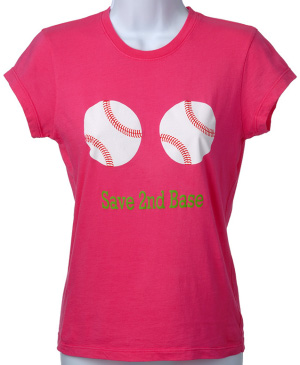 This tee is also interesting in how it appropriates a "sport" theme, used as a metaphor for sex that is wholly centered on what the male "gets" the female to do, especially considering the objectification of women in sport. Compare to this tee, also on a sport theme:
 So to recap, not only are saving the breast not the woman, the focus of the campaigns, but the reason for doing to isn't even about preserving the sexual pleasure that the woman's breasts give her, but is instead about their benefit to others, predominately to men--not only your (presumed male) partner, but to the community of men at large. "We men" love 'boobies' so we'll work real hard so you don't have to have them surgically removed. And we women should be "responsible" and look after them because the dudez love 'em. And we all know women should do things about their body because it's what men love. Not because, well, women might die!


I prefer this one:
Rethink's "Booby Wall" starts off saying about it's call to upload images of your breasts: "this isn't Maxim...this is beautiful" only to be followed by "this is worth living for." Excuse me? Um, no, my breasts are not worth living for, my life is worth living for! Yeah, let's display all sort of breasts as examples of the beauty in the variety of breasts to prove that your breasts are important, valuable and worth living for. Gee, that sure sounds like an awesome initiative!
And no, this is not a case of Aw, just lighten up!-Whatever will get people to fight breast cancer-What's the Big Deal? No, sorry. This is the message women get ev-ry-where. And now when the issue is supposed to be about women's lives, we're appealing to save women's bodies?! Women's bodies are valuable regardless of what they mean to men and the male gaze, and women's lives are important regardless of their bodies. End of story.
Reasons why we fight breast cancer?
Because it kills women.
Because it takes a chunk of your life away.
Because a woman losing her breasts can make her lose out on sexual pleasure.
The "because a woman's partner may lose our on sexual pleasure" is at the bottom of the list.
That "men like looking at as many breasts as possible and anything that makes them go away should be fought against" is not on the list.
In addition to my disclaimer above, an ending disclaimer. I am not criticizing men that are involved in breast cancer organizations whatsoever. Please keep it up! I am criticizing the way that action against breast cancer is framed, and I am not saying men involved are doing so with the motivations presumed by the campaigns. Instead, I think this tee better describes these men:
The campaigns rely on a sexist framework regarding the female body and what/who it is for, and they perpetuate such sexism in the design of their campaigns.
*Even though the way breast cancer has been produced in medicalization has a very gendered element to it, in the way that the comparative silence around prostate cancer and prevention is also quite gendered. I'll write on this in the future. But for now, ponder on why it might be that we encourage women to do self-breast examinations monthly--and this is a common-knowledge thing--and we don't advocate men doing self-testicle exams. Even though considering the various tissue obstructions in the breast, it would be much easier to discover lumps in the testicles than in the breast.
(Cross-posted to The Reaction)
Monday, April 14
McCain defends masculinity by resorting to sex-based insults
OK, so this has been mentioned everywhere, but in The Real McCain by Cliff Schecter, he claims that McCain responded to his wife's comment about his hair thinning by calling her a 'cunt.'
From the book, via Feministing:
At one point, Cindy playfully twirled McCain's hair and said, "You're getting a little thin up there." McCain's face reddened, and he responded, "At least I don't plaster on the makeup like a trollop, you cunt." McCain's excuse was that it had been a long day.For the record, trollop means "prostitute" or "promiscuous woman."
(Interestingly, dictionary.com phrases this to imply that a prostitute is a particularly promiscuous woman, as if prostitution as sex work and individual promiscuity for one's own pleasure -not work- are in fact conceptually related).
See my previous posts on sexed bodies and gendered insults, and on gendered language more generally.
No further comment required. Keep Reading...
Friday, April 11
Thesaurus.com Says 'Female' is Equivalent to 'Weaker'
Both feministing and Jezebel reported this week that a Thesaurus.com entry has shown up for the word "weaker" where the only two entries are "female" and "lady." The entry has been removed so you can view the screenshot here.
My guess is this was supposed to be some sort of a joke, since not only have those two synonyms been removed, but if you look up "weaker" in Thesaurus.com, there is no entry for it, period, only for "weak." From looking at the site, though, it doesn't seem to be user-generated so if it was a joke, it was an "inside" one or a hacker--I hope.
Not only am I bringing this up because it is so blatantly sexist, not to mention completely unproductive, say for a student needing a real synonym, but because this connects a great deal to my previous post about gendered-language and the denigration of the female that is encapsulated by the term pussy, but also because language politics in terms of gender/sexuality has been popping up in the news. A couple weeks ago, weakness was aligned with femininity in the recent commentary on Obama's bowling performance, and Christopher Hitchens' characterized (gay male) Andrew Sullivan as acting like a 'lesbian' in order to insult him.
This Thesaurus.com incident proves how deeply embedded these associations are in our culture-- whether it goes to show that woman is "officially" connected to the meaning of "weak" or that a hacker understood this cultural connection and attempted to embed it into institutional discourse.
The synonyms they provide for the "weaker" synonyms "female" and "lady" are seems to be taken from the actual entries for various woman-related terms. And as long as we're talking about language and thesaurus.com, lets do some word analyzing.
"female":
noun-amazon, babe, beauty, broad, cutie, dame, doll, dowager, duchess, femme, filly, fox, gal, gentlewoman, girl, lady, madam, mama, matron, petticoat, pinup, seductress, she, siren, sis, skirt, temptress, tomato, wench; adjective-changeable, child-bearing, delicate, effeminate, effete, fair, feminine, fertile, gentle, girlish, girly, graceful, ladylike, maidenly, matronly, modest, muliebral, oviparous, petticoat, pistil-bearing, pistillate, pure, refined, reproductive, sensitive, she-stuff, shy, soft, tender, twisty, virgin, vixenish, weak, womanish, womanlike
vs. "male":
noun- ape, beefcake, boy, bruiser, buck, bull, chap, dude, father, fellow, gent*, gentleman, guy, he, he-man, hunk, jock, john, macho man, papa, stud, tiger, tom, wolf; adjective-macho*, manful, manlike, manly, potent, virile
Notice anything? Perhaps an emphasis on sexual appeal in terms of being female and sexual action in terms of being male? Perhaps mostly terms of confidence, self-identity, and positivity for male while female terms are largely relational (not individual), object-like, or negative.
Looking closer at these listings for each...
So how about looking at "girl":
babe, baby doll, bird, blonde, bobby-soxer, boytoy, broad, butterfly, canary, chick, coed, cupcake, cutie, dame, damsel, daughter, deb, debutante, doll, female, filly, gal, jail bait, lady, lassie, mademoiselle, maid, maiden, minx, miss, missy, mouse, nymph, nymphet, piece, queen, schoolgirl, she, sis, skirt, spring chicken, teenybopper, tomato, tomboy, virgin, wench, witch, woman
vs. "boy":
buck, cadet, chap, child, chip, dude*, fellow, gamin, guy, half-pint*, junior, lad, little guy*, master, punk*, puppy*, runt*, schoolboy, shaveling, shaver*, small fry*, sonny*, sprout*, squirt*, stripling, tadpole*, whippersnapper*, youngster, youth
Looking at the girl/boy listings, of which there were 50+of each...
You might be thinking, "it's just Thesaurus.com...what's the big deal?" Well, Thesaurus.com and Dictionary.com are heavily used and are considered reputable sources. And words mean things. Language shapes thought, and what we are able to think. So long as we overload terms for female with passivity, sexualization, objectification, and motherhood, and male with activity, active sexuality and prowess, we will continue to think of men and women in these terms. Think about it--what do we call a woman who's sexually active--slut, loose, whore? What do we call a passive male sex object? Um, hunk...maybe? Or meaty? And of course juxtapose those terms with "delicate," "weak," and "sensitive," and maybe now we're seeing this isn't just an issue of a word or two.
And when "mama's boy" is an anomaly of "boy" while "tomboy" is part of the definition of "girl," we have some serious heteronormativity in our language. And when nymph and virgin, doll and cutie are the way we think of young girls rather than simply being not-yet women, some light is shed on our incredible social problem of girls' sexualization and the sexualization of the young and vulnerable (even if legal) in general. And why is there no term for an intelligent girl, like we have for "boy wonder"....just "cover girl"?
When we can't think without words, when we understand that words do not simply reflect our thought but actually shape it, we can begin to understand that they're not just words.
*for more of the same, check out dictionary.com for "woman" and "man."
cross-posted to The Reaction
Sunday, February 17
Randon Act of Feminism for February/March : Gendered-Language Watch
I've decided to start a monthly "Random Act of Feminism"- a suggestion of something you can do to make feminism or feminist thinking visible in daily interactions with others. Among all of this cultural analysis, feminism is both useful and relevant to everyday life!
We're halfway through February, so this will be a 2-month deal, which is actually pretty appropriate considering February and March are the token "appreciation" months for women and African-Americans. Which in my book pretty much boils down to this:

But this Random Act regards women and people of color (in addition to other social minorities) specifically, so in a way, I suppose it's "appropriate."**
Without further adieu....
Gendered-language watch
In conversation (your own and others'), watch how people are described. Typically, we use "identity" descriptors only with reference to women, gay men, lesbians, people of color, non-Western ethnicities, (and also non-Christian religions)...in other words, the default category for a "person" is a white, hetero, male. A person is only someone "other" than that when specified.
This is what's referred to as "ex-nomination" (coined by the semiotician Roland Bathes)-being 'unnamed'. What is unnamed is what is seen as a 'natural' commonsensical category. Those of us who are not white heterosexual men become those with "marked bodies"-bodies who must be named to be identified. In other words, people who are women, or black are designated as such (as if identifying them according to said label adds particular meaning to who they are as a person), while white hetero men are simply "people," and are thus permitted to establish meaningful identities in ways not shaped by said societal identity labels.
Listen for it-you'll be surprised. Start correcting your own speech and kindly point it out in others'. Usually these identity markers are completely irrelevant to the context of what's being said-and using them continues to produce the default category of "person" or "human" in line with how it's been posited throughout history, and how it's been assumed to be in disciplines such as science, psychology, and philosophy: white, heterosexual, and male. This is a subtle way that norms around gender, sexuality, race, class, &,... are reproduced on a daily basis, through interpersonal interaction. "-isms" (sexism, racism...) need not come in the form of legal discrimination-they often happen in little moments throughout the day in ways we often don't realize...until someone says "hey, wait a sec..."
**These token "history" months are case-in-point. I do not wish to take away from their usefulness-during those months, the promotion of minoritarian history seems like worthwhile endeavors and more people are exposed to those histories than might otherwise be. Indeed, it is sad that traditional disciplines are so WHITE that they are even necessary. But, they are a good example of what I'm talking about as far as exnomination goes. I hear so many people say, "Well, when will we have a men's history month?" The simple (and to me, obvious) answer: every day of every month of every year, in newspapers and classrooms nationwide, is the teaching of men's history. It just isn't called that. "Neutral" history is really the history of dominant culture-it just gets the "privilege" of being called plain-old "history". Why? Oh yeah-because of exnomination, baby! Keep Reading...
Sunday, February 3
Gender Stereotypes and Male Feminists
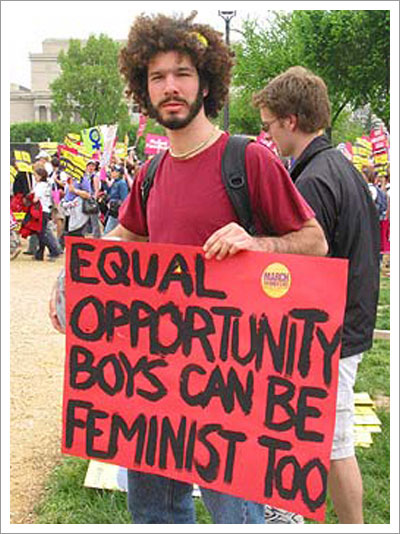 The f-word has a provocative article (written by a man!) about the way gender stereotypes hurt men, why men tend to not fight them the way women through feminism have, and what we should do about it!
First, an excerpt:
Let's not kid ourselves here: men as well as women are limited by gender stereotypes. The idea of men as stupid and sex-obsessed is an enduring generalisation that is allowed to flourish in - dare I say it - a much more brazen way than the stereotypes about women, mainly because no man ever stands up and says: "Hey, that's sexist and it offends me!" The problem is, while women are encouraged to reject the ludicrous ideas that are held about them, men are supposed to embrace them....
...From an early age, women are aware of their gender and what it means for their lives, far more than men are. Feminism encourages women to shed gender stereotypes and consider themselves as individuals. Men simply don't think about gender. Why would you, when it rarely impacts in a noticeable way on your life? Very rarely is your progress barred because you are a man and it is true that male culture generally does not promote frank and open discussion of such issues.
Many men aren't feminists simply because it has never occurred to them that they should be: when you're not faced every day with the challenges thrown up by gender inequality it is very easy to think: "Well, we've changed the law so we have equality now."
And I'd add to his analysis, that often times the gender stereotypes perpetuated for men have the effect of reiterating homophobia and misogyny-so on the one hand, men see little need to challenge them since they don't seem to directly affect their lives, but also they tend to reinforce their dominant position in society (by labeling the "non-manly" as "gay", by using overactive sex drive to justify sexism and objectification...)
In order to combat these stereotypes, gender analysis (feminism!) absolutely has to be embraced. This is not only to prove them false by demonstrating they do not accurately reflect the diversity of men's lives, but also to provide discursive analysis to understand how these stereotypes produce masculinity in particular ways: in much the same way that, for example, feminist analysis showed that the stereotype that women are not as good at math and science as men guided teachers and parents to steer girls away from those subjects at both school and home, after which few women would enter those fields, providing the empirical fact that women do not so well in math and science because few women in fact do work in those fields.
What this example (and many others!) shows is that even if stereotypes do reflect a significant portion of a population, that does not make their manifestation "natural." It is important to look at how masculinities and femininities are produced as such. And as I allude to above, there is much analysis done already that looks at the sexism and homophobia that produces masculinity in particular ways. So if we want masculinities that are rich and varied, and if we want to combat homophobia and misogyny, men need to embrace gender analysis, feminism, and begin to critique these stereotypes on a regular basis in their daily lives the way feminism has been for decades.
May I recommend...
XY online
NOMAS
Books:
Men Doing Feminism
Men in Feminism
The Making of Anti-Sexist Men
Masculinities
Read full f-word article here
Saturday, January 12
the problem with 'pussy'
I am particularly troubled by the word "pussy" being used as an insult where I find other terms for (female and male) genitalia used as insults as less problematic. The difference, as I see it, is in the particularly gendered meaning of "pussy"; it is an insult because of its explicit (negative) link to femininity by the definitions of both slang usages (vagina, and also weak, wimpy, etc.) . The denigration of the female is what makes it insulting, and I don't find this to be the case with other genital-based insults.
Consider: scene from South Park, "Fun with Veal"
Randy: Vaginitis?
Doctor: It occurs when a person stops eating meat. Those sores on his skin were actually small vaginas. If we hadn't stopped it in time, Stan would have eventually just become one great big giant pussy. [ed: become attached to a cause for injustice, have compassion for the oppressed, and turn into an emotional wimp]
...
Stan: Well, I guess we learned something today: it's wrong to eat veal because the animals are so horribly mistreated, but if you don't eat meat at all you break out in vaginas.
[I also can't help but see a-perhaps unintentional-insinuation toward 'meat' as penis-in not eating meat, Stan was acquiescing his masculinity by disposessing himself of meat-the penis, the symbol of male power . As in, cease to be/have a man (read: be a non-heteronormative man or a lesbian), and you become like a woman-a pussy-which clearly isn't a good thing. Also, as in: "don't be a pussy, grow some balls."]
Keep this scene in the back of your mind as you read.
I am prompted to write this posting from recent conversations with people about the politics of words, and more specifically, slang (for more on this topic, look for my future posting about the "naggers" South Park episode). I am writing specifically on my distaste for the word "pussy" in it's secondary slang sense (as an insult meaning weak, wimpy, or to define slang with slang, without "balls," it's first slang definition being vagina). Further, I want to explain how I see this particular word functioning differently than other derogatory terms for sex organs, male or female.
First, what does "pussy" mean? Weak, wimpy, passive, gutless, spineless, able to be "fucked over", one who just "takes it"; it tends to be used when someone is seen as "overly" (whatever that means!) sensitive or emotional or caring, or is unable to "handle it"-stress, pressure, etc. Do we see a pattern? Yes!-these are all traits that are traditionally associated with women. When has pussy traditionally been used? As an insult to men-not that unlike "stop acting like a girl." However, as feminism has pushed society into recognizing that, hello!, these are not traits of women by nature, Western culture still recognized these traits as feminine even if they no longer are necessarily considered traits of females. And subsequently, "pussy" as an insult is now directed at women as well. To have called a woman a pussy in earlier times would have been redundant.
Why is "pussy" as an insult offensive? Well, I think that is self-evident: using a part of the female anatomy as an insult for someone is degrading, especially when said anatomy has been thoroughly denigrated by Western cultural ideology as ugly, unclean, smelly, who in its adult form is deficient and whose role in sexual practice is considered to be passive and secondary. I am not saying this is what everyone thinks as individuals, but this is our ideology-our system of cultural values that reinforces existing ways of thinking and presents them as natural-"the way things are." Not only is "pussy" an actual insult, but we find actual pussies (meaning, vaginas) to be plain icky and in need of physical and chemical alteration.
So what do I think of other anatomical terms used as insults-dick? cock? and the motherload-cunt? The bottom line for me is that I typically don't use any of these terms as insults. One exception I can think of is a strategic/political one: I will sometimes call a sexist man a "dick." I use it rhetorically because of the phallocentric nature of sexism, where power comes by (seeming to) possess the phallus, which is not literally the penis, but rather is symbolized by the penis. Thus, I may refer to a misogynist, phallocentric, sexist man as a "dick." In that way, I'm being ironic. But I digress...
While I choose to not use the body's sexuality as an insult to anyone, I still maintain a qualitative difference between how pussy vs. cock, dick, and yes, even cunt, function. Sure, they are all negative, insulting slang terms. Dick means something like jerk, and cock usually indicates an excess of assertion, aggression, self-centeredness; I think of them in similar meaning and usage to the term "bitch," which also makes a reference to gender (a female dog), and is usually the word of choice when referring to women (it seems odd to me to think of a woman being called a "dick"). And I can't think of a definition of the word cunt, but to me, that is the worst possible insult you can give a person. And while I am less than thrilled that a term for vagina is also the ultimate insult, it and the male terms do not trouble me like pussy does.
Why is that? Do I have a double standard? Not really. I do not see the insulting quality of dick, cock, or cunt to be in their negative reference to said gender. Is cock an insult because its meaning is linked to the derogation of it's referent-the penis, or being male? How about for dick? And I'm unsure abot cunt, but for right now I'll err on the side of saying no, it doesn't either. The very thing that makes pussy an insult is its explicit link to femininity. It is insulting because it 'feminizes' its recipient, and being feminized is a bad thing because being female and traits associated with femininity are bad! negative! insulting! And not just for men, as an affront to their masculinity, like it used to be (think: army trainees). Under liberal feminism, women have gained equal rights and respect in that women are seen to be able to behave "like men," rejecting those oh-so-terrible traits simultaneously produced and denigrated by Western culture as "feminine". So, now the pussy insult for women too, whose excessive display of certain "female" traits is seen as a bad thing (unless, of course, "excessive femininity" involves sexual exhibitionism). The insulting term loses its force if it changes to something other than pussy; it has particular meaning only because of the affiliation between women, and-quite literally-their vaginas, and what pussy as an insult is meant to convey. And that simply is not the case for dick, cock, and cunt. Pussy is an insult because of its gender connotation, the others are in spite of their gender connotation.
Food for thought: what other term might we use in place of pussy to insult someone for weakness/wimpiness? Oh I know, fag! And that's a related topic for another day...
Oh, and the next time someone calls you a pussy, consider replying:
Wow, thanks! I didn't realize you thought I was a sensuous, aromatic, pleasurable, warm, delicious, sexy, exciting, sensitive, pleasing, responsive, channel of life?! I appreciate you sharing that with me!
and tell them why using sexist and offensive language makes you an, er, um, dick. :-P

UPDATE 2/15/08: from feministing.com:And I can tell you, [John Edwards is] really skeptical of her ability to be the kind of president he wants. But, he kinda thinks Obama is..he thinks Obama is kind of a pussy. He has real questions about Obama's toughness, his readiness for the office.
Case in point!


